

Tracing the lines of our maternal ancestors in the 1700s often feels like chasing shadows across the pages of history. While their husbands, fathers, and sons left behind paper trails of land deeds, wills, and public records, the women of the colonial era are too frequently reduced to mere initials, gaps between census years, or first-names-only in a family tree. Yet, breaking through that silence rewards us with remarkable stories of connection and community resilience. A perfect example is Magdalena Tyson Hunsberger Gottshall (1787–1864). Far from a footnote, her life served as the geographic and genealogical anchor that bound together four powerhouse families—the Tysons, Hunsbergers, Zieglers, and Gottshalls—weaving their separate migrations into a singular, enduring legacy in early southeastern Pennsylvania.
FATHER ABRAHAM
Abraham Hunsberger Jr. (1755-1816) is known for a very interesting Revolutionary War story that took place shortly before he married Catherine Nash Tyson (1760-1819). As a devout Mennonite, Abraham held fast to a non-resistant faith that forbade taking up arms. Yet, remaining non-combatant did not mean staying passive when neighbors and family were suffering.
During the harsh winter of 1777–1778, while Redcoats occupied Philadelphia, British troops aggressively stripped the surrounding countryside of provisions. Local American sympathizers trapped inside the city faced severe shortages. Driven by conscience and community ties, Abraham took a daring gamble: he began secretly slipping farm produce past British patrols to deliver food to the struggling population inside Philadelphia.
It was a risky game along the Perkiomen and Schuylkill corridors, and Abraham’s luck eventually ran out. British guards caught him attempting to bypass their lines, taking him into custody as a suspected Rebel supplier.
Faced with imprisonment or worse, Abraham possessed a quiet, unexpected salvation: his talent for music.
Brought before his captors, the young Pennsylvania German farmer used his musical gifts to break through the hostility of the guardhouse. Singing traditional tunes and playing music for the soldiers, his natural charm and artistic talent completely disarmed the British unit. What could have ended in long-term captivity transformed into an unlikely moment of camaraderie. Charmed by his performance, his captors eased their stance and ultimately granted him a swift release, allowing him to return safely home to his farm!
Not long after surviving the wartime close-call, Abraham married Catherine Nash Tyson in 1779. Together, they established the very homestead in Frederick Township that would become the heart of the Hunsberger and Gottshall family lines—a legacy rooted in a young farmer who preferred making music to waging war. Abraham originally farmed in the densely settled Mennonite lands of Franconia and Skippack. As a young farmer with a rapidly expanding family, land in those older settlements was becoming scarce and expensive. Looking for fertile, affordable acreage to establish his large household, Abraham purchased a farm further up the Perkiomen Valley in Frederick Township (just outside Schwenksville). They weren’t moving into the wilderness alone—they were joining an established network of extended relatives. In fact, Magdalena’s maternal aunt, Mary Tyson, had already moved to Frederick Township back in 1775 with her husband, Jacob Shoemaker, who operated a highly successful local oil mill. This move set the stage for Magdalena to meet her future husband, William Ziegler Gottshall (1784–1875), whose family was firmly entrenched right next door.
COLONIAL FARM LIFE
Magdalena was born the 6th of 13 children on December 30, 1787. The United States had just gained its independence, and life on rural farms returned to a normal routine. On a Pennsylvania German farm, agriculture and the household dictated daily life long before dawn. While her brothers and father headed out to feed the livestock and tend the crops, Magdalena and her sisters were in the kitchen. They started the open-hearth or stove fire, baked bread, and prepared a hearty breakfast of cornmeal mush or porridge. For a young girl during the day, the workload was ongoing and varied with the seasons. Mid-morning was dedicated to spinning flax and wool, churning butter, and tending a massive kitchen garden full of cabbage, root vegetables, and herbs to flavor food and create medicines. In the late summer and autumn, the farm transitioned into harvest mode, requiring long, hard days of preserving food for the months of winter ahead. After preparing dinner for a family of fifteen, the evening was spent mending clothes in a dimly-lit room. Spinning wheels and knitting needles were constantly working; in a family of thirteen children, someone always needed new socks or an old, tattered shirt repaired. Then it was off to bed after a long day of labor, only to begin again at dawn.
Regarding the family’s Mennonite faith, Magdalena was immersed from the moment she was born, inheriting a deeply devout religious tradition from both sides of her family. Her father’s family were pillars of the local congregations, and her maternal grandfather, William Tyson, descended from the pioneer Krefeld Mennonites who helped plant the faith in Germantown. In 1790, being Mennonite shaped everything about Magdalena’s worldview: it dictated her plain dress, her Pennsylvania Dutch language, her community-focused lifestyle, and her commitment to non-resistance following the recent turmoil of the Revolutionary War. This faith remained for her entire life.
MERGING OF THE SUPER-FAMILIES
On October 18, 1808, the keystone threads of these colonial family-lines tied into a knot with the marriage of Magdalena and William. This was far more than a union between two young neighbors—it was the official convergence of four early Pennsylvania German powerhouse families: the Tysons, Hunsbergers, Zieglers, and Gottshalls. William brought with him the legacy of his grandfather, Bishop Jacob Gottshall, and the prominent Ziegler farming line, while Magdalena tied him directly into the early Krefeld/Germantown Tyson network and the expansive Hunsberger tracts of Franconia and Frederick Township.
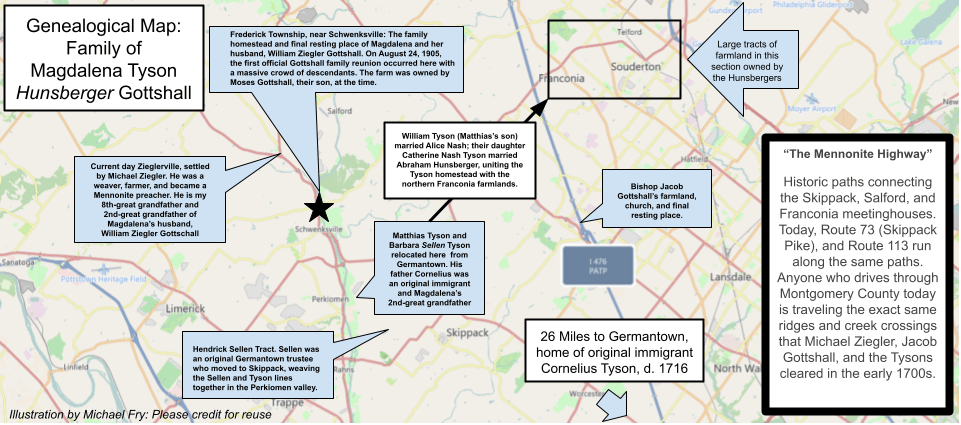
As the map above illustrates, their marriage brought together family networks scattered across the Perkiomen Valley. Magdalena’s Tyson roots traced directly back to the very origins of German settlement in Pennsylvania. Her great-great-grandfather, Cornelius Tyson (d. 1716), was among the earliest Mennonite settlers in Germantown, having arrived shortly after the initial 1683 pioneer wave from Krefeld. As land in Germantown filled, his son Matthias Tyson moved north into Skippack and Perkiomen Township, establishing the family farm where Magdalena’s grandfather, Peter, and father, William, would grow up. It was this gradual northward migration along the Perkiomen Creek that eventually placed the Tysons right next door to the Hunsbergers and Gottshalls. These intertwined lines established footprints across several key townships in Montgomery and Bucks counties:
Montgomery County (carved from Philadelphia County on September 10, 1784)
Franconia Township & Telford: This served as an epicenter for both family lines. Generations of Gottshalls and Hunsbergers lived, farmed, and intermarried here. The Franconia Mennonite Church Cemetery became a central burial ground for many prominent figures of both names throughout the 18th and 19th centuries.
Lower Salford & Lederach: Originally part of early Mennonite land allocations, areas like Lower Salford and nearby Harleysville were prominent strongholds where both families held substantial agricultural plantations.
Towamencin Township: An early foundational area for the Gottshalk line following their migration inland from Germantown. Descendants continued to maintain a strong presence here through the early-to-mid 19th century.
Frederick & Marlborough Townships: Census records from the 1840s through the 1860s highlight branches of the family moving slightly northwest within the county into communities near Schwenksville, Frederick, and Sumneytown, working as farmers, millers, and local tradesmen (such as weavers and dyers).
Limerick Township: A significant hub specifically for several prominent branches of the Hunsberger line during the late 1700s and early 1800s.
Northern Bucks County
Bedminster, Hilltown, & Rockhill Townships: As generations expanded out of Montgomery County, notable branches of the Godshalk and Hunsberger lines established deep roots across the county line in Bucks County. They became vital members of the Blooming Glen, Deep Run, and Rockhill Mennonite congregations, operating adjoining homesteads and local small businesses.
MAGDALENA’S FAMILY
Together, William and Magdalena established their home in Frederick Township, anchoring a farming life rooted deeply in their shared Mennonite faith. Family tradition holds that Magdalena had a keen memory and possessed the remarkable ability to sing—entirely from memory—virtually every hymn in the traditional German Mennonite hymnal. Without opening a book, she could recall dozens of lengthy, complex, multi-verse theological hymns, holding every verse and tune clearly in her mind.
Where did this tradition come from? In the 1700s and early 1800s, local congregations like Skippack, Franconia, and Schwenksville relied on hymnals like the Ausbund (the historic Swiss/South German Anabaptist hymnal) and later the Unpartheyisches Gesang-Buch (first printed in Lancaster in 1804). These hymnals contained hundreds of dense, un-notated pages of text. Because hymnals were costly and not every family owned multiple copies, worship depended on two things: the chorister lining out the verses, and the extraordinary memories of devout worshipers who carried the songs in their hearts.
For Magdalena, those hymns weren’t just for Sunday meeting. As she spun flax, tended the kitchen garden, mended clothes by candlelight, or rocked her 13 children to sleep in their Frederick Township home, she sang. Through decades of daily farm labor, those melodies served as her quiet sanctuary.
This oral archive wasn’t lost when she passed away in 1864. She passed those traditional tunes down directly to her children—most notably to her son, Rev. Moses Hunsberger Gottshall (1815-1888), who eventually became a bishop, and used that rich vocal tradition during his forty years in the pulpit at Schwenksville. In a time before recordings or widespread literacy for women, Magdalena’s mind served as a living bridge, keeping centuries of Anabaptist musical heritage alive for the next generation of Pennsylvania German families. Her grandson, Moses C. Gottshall, inherited the family homestead and hosted the first official Gottshall Family Reunion on August 24, 1905. This gathering inspired the creation and publishing of the 1925 book, A Genealogical History of the Gottshall Family by N.B. Grubb. Gottshall Hunsberger Gottshall (1816-1906) remained in Montgomery County, was a farmer and tradesman. He lived a long life of 89 years, transitioning through the Civil War and into the 20th century, a living link to his parents’ 18th-century roots. William H.(1812-1906), Andrew H. (1825-1909), and my 3rd great-grandfather Adam H. (1813-1889) farmed their land and built an agricultural network through Frederick, Marlborough, and Limerick Townships. Adam eventually relocated to Pillow, Dauphin County. The youngest, Abraham H. Gottshall (1826-1901), became a minister and preached the Word in Berks County, while Dillman H. (1818–1897), Johannes H. (1820–1871), and Jacob H. Gottshall (1822–1896) farmed, worked trades, and anchored the family in Franconia and Marlborough townships.
Magdalena’s daughters also extended the family’s footprint across southeastern Pennsylvania. Her eldest daughter, Barbara Gottshall Bergey (1810–1890), became a long-lived matriarch in Lower Salford, while Catherine Gottshall Hagey and Elizabeth Gottshall Derstine (1811-1892), married into prominent local Mennonite families—threading the Gottshall line deeply into the Hagey and Derstine networks of Montgomery and Bucks counties.
CONCLUSION
While colonial records often leave women in the background, Magdalena’s legacy survives through the hymns she passed down, the four families she united, and the web of descendants that still traces back to her Schwenksville homestead. They lived out their entire lives on this land, witnessing nearly a century of changes in Montgomery County. Magdalena and her husband William are buried together at Eden Church Cemetery, just outside of Schwenksville.


Leave a Reply