
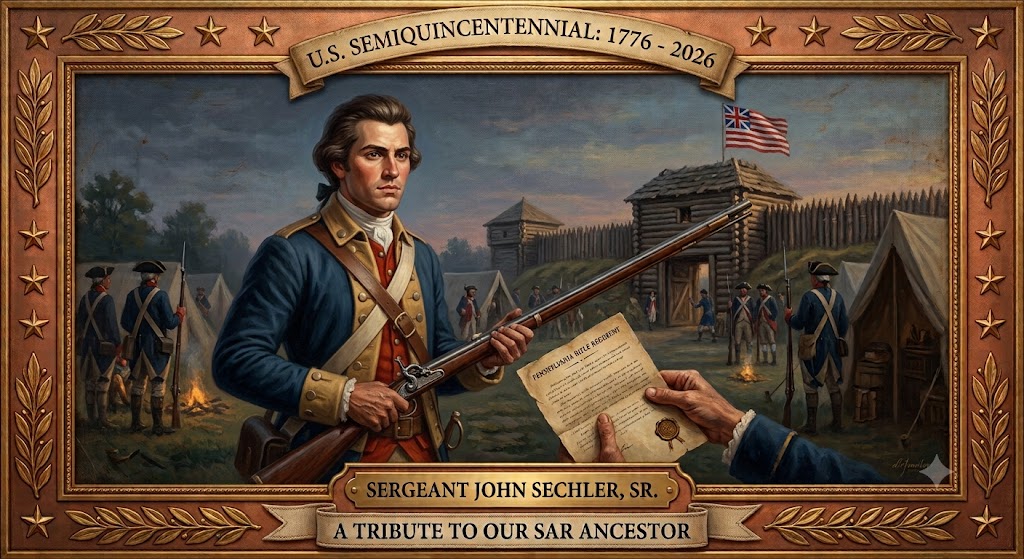
Nearing the 250th anniversary of the Declaration of Independence and birth of the United States of America, I would like to honor my direct descendent, Sergeant John Sechler, Sr. He was a Revolutionary War veteran, early settler of Danville, Pennsylvania, and my Sons of the American Revolution (SAR) Patriot Ancestor.
“YOU GOT ME MONOLOGUING!” Buddy Pine, aka Syndrome, The Incredibles 🙂
When Matthew passed, one of the ways I dealt with grief was to dive into Ancestry.com and start building my family tree. It was 2020, COVID was raging, and not only did we have to deal with Matthew’s death, but we also spent a lot of time quarantined. I never thought I would be the one to care; as a child, I never understood the family terms and hierarchy, and I didn’t pay much attention to my mother when she said, “…that person is a distant cousin…” I have thought about it frequently since then, and I’m now equating my early genealogy research with collecting baseball cards in the 1970s. I was obsessed with buying as many packs as possible to get that one great card, and I’m positive my local candy shop owner was happy to see me walk in the door (shoutout to the Ramin family!).
Anyway, I am finding out that I should not have rushed. Ancestry.com is an excellent resource, but sometimes the algorithms jumble information, make incorrect suggestions, and are just plain wrong! In addition to Ancestry, I also keyed in books published on the Gottshall line and others, which contained many errors. To all of you who dabble out there, be careful when you get a suggestion for an ancestor; do your homework, choose your names carefully, and go slow! I’m now sifting through 6,500 names and trying to sort out the mess I made by following the algorithms to collect as many people as possible.
I became interested in my ancestors and the American Revolution when I discovered that Private Conrad Fry (1753-1842) served in that war. My wife and I tracked down his headstone and paid a local headstone firm to restore it. I was very proud of this discovery and later, when I applied to the SAR, I was going to utilize Conrad as my Patriot Ancestor. I quickly discovered that this was not going to be easy; I had a roadblock or two trying to prove he was my direct ancestor (work in progress), and SAR genealogists are very thorough. I didn’t feel confident in claiming Conrad at this time, so I moved to the Sechler family (my paternal maternal line) to see what I could find. Quite honestly, I had mostly ignored the Sechler line of my family and focused on others, including my wife’s main allied lines. I was pleasantly surprised by the amazing stories from the Sechler line (stay tuned), including a Patriot Ancestor who was already documented many times in the SAR and my sixth-great grandfather: Sergeant John Sechler, Sr.
MOVIN’ OUT
I mentioned in an earlier post that John’s father Johannes Sechler purchased “investment property” in Lynn Township, Pennsylvania, in 1750, as required by the tenets of William Penn’s land agreement. My theory encapsulates the idea that not all of Johannes’ family migrated there; rather, some of the sons left to develop the new land, while the rest of the family remained in Upper Hanover Township. Seven years later, the tragedy of the Allemangel Massacre occurred, where Abraham Sechler’s child was killed and his wife was shot twice and scalped, but survived. This incident may have been a catalyst, or possibly the brothers just had a yearning to expand and improve their lot in life.
Just prior to the American Revolution, circa 1772, John, Jacob, and Joseph Sechler made the arduous trip to the Mahoning Creek watershed (now Danville, Pennsylvania). Two of John’s children were born in Danville around this time, so I assume his wife, Christina Fischer Sechler (1750-1825) accompanied the men on the trip. Jacob and Joseph ultimately returned to eastern Pennsylvania to live out their lives, so they most likely made the trip to support their brother on the journey and to carve out a homestead. I researched the most likely route to Danville from Lynn Township, which included crossing the Blue Mountain through a nearby gap and following a Native American trail through rugged mountain gaps along the way to Sunbury, near Fort Augusta. From there, they would paddle upstream for 15 miles on the North Branch of the Susquehanna to the mouth of Mahoning Creek. This trip covered 60 to 70 miles through dense forest, mountain ridges, swamps, and river. The journey probably took 4 to 5 days of intense travel, just to arrive in a desolate area with no comforts and the constant fear of attack from Native Americans.
WHY MAHONING CREEK?
A move of this magnitude, during this time period, would have to carry a high chance of reward. For John Sechler, future Danville held some special advantages to ensure his success. First, Mahoning Creek is a larger creek with water that moves fast enough to support a gristmill and sawmill. Second, future Danville is just 12 miles from Fort Augusta (Sunbury)—close enough to flee if attacked, but far enough away to purchase cheaper land. Finally, he was located directly on the Susquehanna, where any goods produced could be easily shipped downstream to established cities.
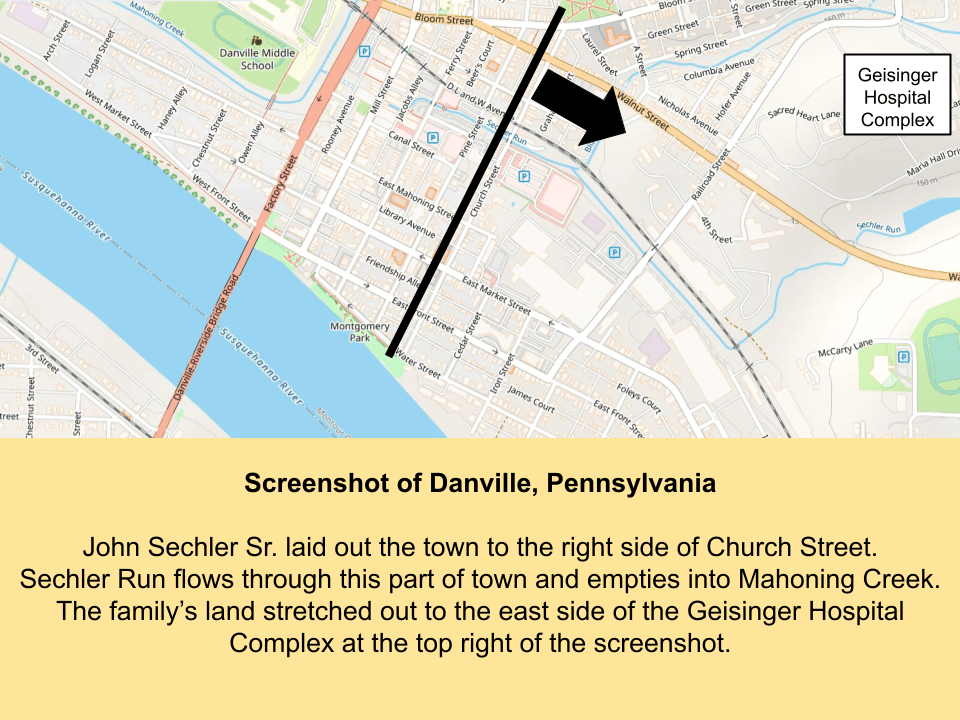
This paragraph may be a bit controversial, but I am convinced that the only permanent humans in the Mahoning Creek area before the pioneers arrived were the Lenni-Lenape Indians, living in a settlement at the mouth of the creek. When the Sechler party first staked out their claims in the early 1774 frontier, they were looking at a truly pristine, raw wilderness. While William Montgomery was already acquiring land in the area, it wasn’t until 1792 that his son, Colonel Daniel Montgomery, formally designed the town grid between Mill and Church Streets. The town was ultimately named for Daniel’s economic expansion—evolving from “Dan’s-town” to Danville—rather than the pioneers who first cleared the land. Given that John Sechler, Sr. staked his claim early and later laid out the town plots just above Church Street, maybe we should rename the place Sechlerville??
CALL TO ARMS AND THE GREAT RUNAWAY
When John, wife Christina, and his brothers Jacob, and Joseph arrived at the Mahoning Creek watershed around 1772, they weren’t greeted by rolling, ready-to-plant pastures. They walked straight into a wall of old-growth, virgin forest.
Talk about a daily grind! A strong, healthy frontiersman could maybe—maybe—clear two or three acres a year. They “girdled” the massive trees by cutting a deep ring through the bark to kill them, built their initial log homes, and planted their earliest crops of corn and wheat right there among the decaying stumps. Every single inch of that early settlement was won through immense, back-breaking physical labor.
You might think that being out on the frontier meant they were completely isolated from the news of the American Revolution. Not a chance! Just twelve miles downriver sat Fort Augusta, the primary military headquarters and communication hub for the entire upper Susquehanna Valley. News of the Declaration of Independence—and the escalating violence of the war—came riding straight up the river with dispatch riders, traders, and local militia men. All able-bodied men were required to enlist, or face fines and harassment if they declined to participate.
By the summer of 1778, the war was no longer just news from a dispatch rider; it was literally at their door. British forces and their Iroquois allies had unleashed the Wyoming Valley Massacre just upriver, slaughtering hundreds of militia and settlers. When that terrifying news hit the Mahoning settlement, it triggered a massive, desperate evacuation known to Pennsylvania historians as The Big Runaway.
Imagine the agonizing choice they had to make. The Sechlers had to grab whatever absolute necessities they could carry, abandon five years of grueling labor and unharvested crops in the wilderness, and join a frantic parade of rafts, canoes, and boats fleeing south down the Susquehanna River for their lives. Through all of this grueling labor and mounting terror, we have to recognize the sheer grit of Christina. She wasn’t just a bystander; she was holding a frontier household together under harsh conditions, managing the crops, and the survival of her family while the men cleared the land. By the time the Great Runaway forced them onto those frantic riverboats in 1778, she wasn’t just fleeing for her own life—she was corralling a handful of very young boys, including little Rudolph and John Jr., clutching her toddlers as they launched into the unknown.
MILITARY SERVICE
John Sechler’s military service wasn’t the kind that makes it into the history books—it was the grueling, thankless work that kept the frontier from collapsing entirely. As a Sergeant in the Pennsylvania Militia, John spent his time on the edge of the frontier, overseeing troops standing guard at vital outposts and patrolling the dangerous gaps between the Susquehanna and the British-allied strongholds to the north.
This was a war of nervous patience and sudden violence. My son Matthew used to say everything in the military was “hurry up and wait”. John’s days were defined by the constant tension of knowing that any rustle in the brush could be the British or Native Americans looking to attack, and his nights were spent in the wet, cold Pennsylvania woods, looking for movement in the dark. It meant leaving Christina and the boys behind in the relative safety of a more settled area, knowing he was among those responsible for the defense of the region. He served because, for a man like John, the defense of his home wasn’t a choice—it was a duty he shouldered alongside his neighbors, holding the line until the war was won.
RETURN TO MAHONING CREEK
John and his family returned to the Mahoning Creek watershed around 1782, once his final term of service under Captain Kern had concluded. There is no record of the brothers returning, so the John Sechler family was probably on their own. They likely found their land overgrown, their home weathered, and the fields reclaimed by the forest. The intense work of clearing began again. While they were among the very first to break that ground circa 1772, they were not truly alone in the region when they returned. General William Montgomery had been acquiring land in the area even before the war, and as the frontier stabilized in the early 1780s, the trickle of returning pioneers and new settlers began to form a growing community.
JOHN AND CHRISTINA’S CONTRIBUTION TO DANVILLE
The John Sechler Sr. family were not only the pioneers of Danville, but John laid out the town on the right side of Church Street, sometime before 1792. He donated portions of his land that was used for cemeteries, churches, and schools. John and Christina’s children, Rudolph, John Jr., George, Samuel, Jacob, and Harman were influential to the development of the town, as well as future generations well into the 1800s. Just as he imagined when the land was purchased, Danville developed into an important stop along the North Branch of the Susquehanna River. John remained in the area as a farmer and died at 92 years of age on October 5, 1831. He is interred at the Old Presbyterian Church Cemetery in Danville.
A FINAL KEYSTONE THREAD
Discovering John Sechler’s role in founding Danville brought an unexpected family connection full circle for me. Decades after Sechler helped lay out the town’s streets, Danville became an industrial powerhouse. In October 1845, the Montour Iron Works right there in Danville became the very first mill in the United States to successfully manufacture a T-rail—the standard T-shaped iron rail that revolutionized American railroads.
Fast forward to the early 1900s in Williamsport, where my great-grandfather, Jesse Fry, made his living working as a T-rail straightener. I love the thought that more than a century after my Sechler ancestors helped pave the way for Danville, a Fry ancestor was working with the very railroad technology that put that same town on the map. It’s funny how these family threads weave together across generations, turning a significant national milestone into a deeply personal history.


Leave a Reply