
Jesse Arthur “Hookey” Fry Sr., my great-grandfather, was born on March 10, 1883, and died on June 11, 1923. He lived an impactful life during those 40 short years. Jesse was the son of Thompson “Mitchell” Fry (1854–1927) and Rosanna A. Lutz (1860–1934). Mitchell was born in Centre County, near Milesburg, and made his way to South Williamsport circa 1879 to continue his work as a “puddler”—a critical, highly skilled position in the iron-making process.
During the 1870s and 1880s, Williamsport, Pennsylvania, was famed as the “Lumber Capital of the World,” but the area was also booming in the furniture-making and iron industries. Mitchell remained single until he finished his work in Centre County and moved to South Williamsport, marrying Jesse’s mother, Rosanna, in 1880. Jesse was born as the second of their seven children.
EARLY YEARS
There isn’t a whole lot of documented information on Jesse before age seventeen, but his home, school, and employment are all in the same neighborhood, as pictured in the image below.
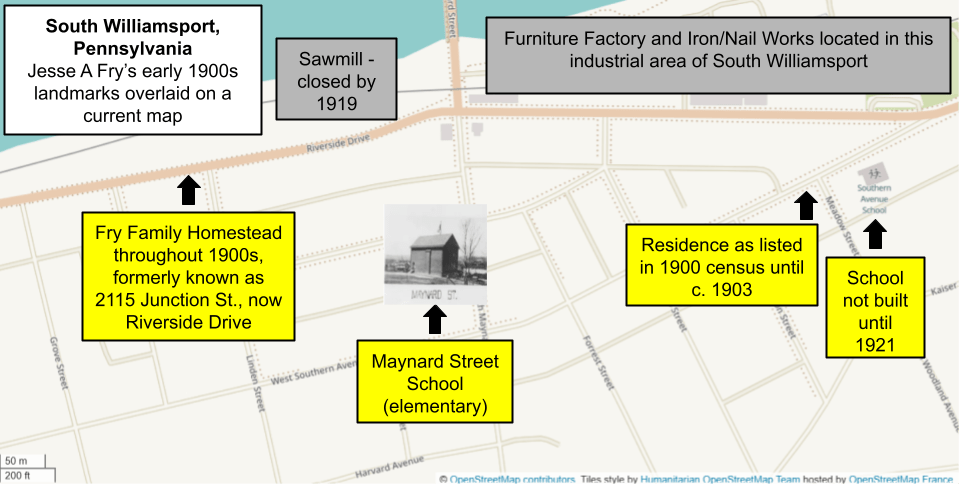
Tragically, most of the 1890 U.S. Census was destroyed in a 1921 fire at the Commerce Building in Washington, D.C., so details regarding the Fry family at this time are sketchy. Jesse would have been seven years old and was most likely attending the Maynard Street School for his primary education.
The 1900 census listed the family as living on Southern Avenue. I tracked the census taker’s route over a number of pages and found the home recorded as the third family on Southern Avenue, just past Meadow Street. Jesse was now 17 and listed as a laborer at a furniture factory, most likely the West Branch Furniture Company or J.K. Rishel. A young laborer of Jesse’s age was responsible for moving planks of rough-cut lumber, catching cut boards, rough sanding, feeding the boiler with scrap wood, and keeping the shop floors clean. His father worked as a puddler at the iron works, and his brother William (1881–1954) worked as a laborer at a local cooper shop, hauling lumber and helping assemble the heavy wooden barrels used by local industries to ship goods across the country.
YOUNG ADULT LIFE
Jesse remained single in his early 20s and developed a taste for traveling for employment, beginning circa 1901. A blurb in the local newspaper on January 17, 1902, mentioned that Jesse had returned to the area to begin employment at the Nail and Iron Works after working in McKeesport, Pennsylvania.
There would be more trips, but first, a bout with typhoid was recorded on 15 November 1903. Nowadays, we take some illnesses for granted, but in 1903, typhoid fever was a serious threat that killed many. In 1903, Pennsylvania’s public drinking water was not regulated by the state. Towns like South Williamsport drew their water from local reservoirs and creeks, while populated areas and industries dumped their raw sewage and industrial runoff directly into the Susquehanna River. Typhoid is a water-borne bacterial infection that spreads rapidly through local water systems. In fact, 1903 was significant as Pennsylvania suffered some of the worst typhoid epidemics in history! In fact, Clara Barton, founder of the Red Cross, got involved one more time before retirement during the Butler, PA epidemic of 1903. Jesse Fry was a strong young man, and fought off this brutal infection, but the illness lasted for weeks and brought exhaustion, high fevers, delirium, and a distended abdomen. Roughly 10 to 20 percent of typhoid cases in the early 1900s were fatal. Recovery from this illness was slow and often left survivors weak for months.
Post-recovery, Jesse accepted an unspecified position in Wisconsin, which, based on his future occupations, may have been in construction. This lasted until 1907, when a newspaper article noted that he was back in South Williamsport and had been rehired by the Iron and Nail Works. Shortly after returning to work, on April 22, 1907, Jesse and another individual were arrested and accused of assaulting a constable at the Iron Works facility. The case was argued, and charges were ultimately withdrawn on June 5, 1907, at the Lycoming County Courthouse.
On a more pleasant note, Mitchell and Rosie Fry held a well-attended 25th birthday party for son Jesse on March 8, 1908. Over 40 people gathered and enjoyed a day of music, song, and a great meal, as recorded in the local newspaper.
The years 1909-1911 included employment volatility once again. The 1910 census recorded Jesse working as a “rolling hand” at a “roll mill”. This is an upgrade from his previous work, as this new job was fast-moving, hot, and dangerous. White-hot metal was pushed out of the heating furnace, and using long tongs, the rolling hands had to catch the ultra-hot metal bar as it was ejected, then physically guide the metal into the next roller to make the metal even thinner. This was a team-based job that required a high degree of coordination; with failure resulting in horrendous injuries or death. Jesse continued to live with his parents, and was not yet married.
During this period, he was recruited to work in Mexico City in 1909 and Rio de Janeiro in 1910, likely for jobs in construction or his area of industrial expertise. Both cities were experiencing unprecedented growth at the time, and recruiters were scouring the globe to find qualified men to assist with modernization projects. Jesse took advantage of the high-paying job offers and the opportunity to travel the world. He returned from working in Central and South America circa February 23, 1911. The Sunday Grit reported that Jesse and the other workers had interesting stories to tell about how America provided the brains and muscle to build cities in Brazil. Based on newspaper documentation from the era, Jesse must have accumulated some wealth, as he was frequently reported going on hunting trips to English Center and fishing trips to Waterville.
MARRIED LIFE
A marriage license between Jesse and Lena Luxenberger of DuBoistown was reported on July 4, 1912, by the Williamsport Gazette and Bulletin. A year later, on July 11, 1913, a real estate transfer occurred where her sister, Mary Catherine “Mazzie” Luxenberger, deeded land in DuBoistown to Jesse and Lena. The exact address was unspecified in the newspaper. The Fry and Luxenberger families were connected in the community for many years, both at social gatherings and through marriage; Jesse’s brother, William M. Fry (1881–1954), had previously married Lena’s sister, Catherine “Katie” Luxenberger (1880–1945).
The following year, my grandfather, Jesse Arthur Fry Jr., was born on November 16, 1913. He was the only child born to the couple. My personal impression through my research is that Jesse continued to enjoy the lifestyle he had before marriage, making various fishing and hunting trips. An article was published on March 17, 1917, about a shared birthday party with his friend John Bower, the proprietor of the Central Hotel. The Central Hotel was located just a couple of blocks down from the family residence, implying that Jesse may have visited there regularly. Unfortunately, all was not perfect with Jesse and Lena’s marriage. In June of 1919, Lena accused Jesse of assault and battery, though I was unable to determine the legal outcome of this accusation in the court records.
A newspaper article in 1922 mentioned Jesse working at Sweet’s Steel Company. By 1922, Sweet’s Steel was expanding rapidly on Williamsport’s West End to meet the post-WWI industrial boom. Jesse was likely making a daily commute from the family home across the river to the West Third/Fourth Street industrial corridor. Because Sweet’s Steel specialized in re-rolling steel rails, Jesse’s highly dangerous, specialized skills—catching and guiding white-hot metal bars into the rollers—made him a perfect fit for a role as a rail straightener. A rail straightener was a highly skilled position, requiring immense precision to recondition industrial and mining rails with 100 percent accuracy.
FINAL CHAPTER
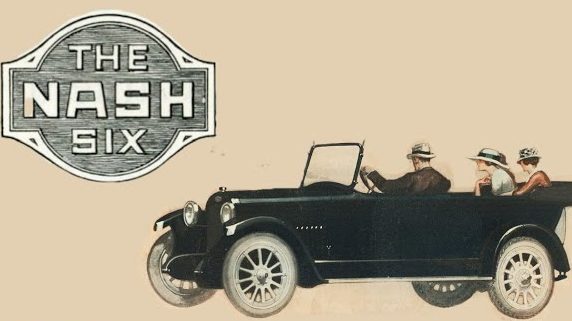
Jesse’s event-filled life came to a tragic end at just 40 years of age. On the night of May 27, 1923, Jesse was a passenger with some friends in a Nash touring car driven by Max Burkhart. Mr. Burkhart was driving without a license when he crashed into a telegraph pole and descended into a New York Central railroad culvert at Larry’s Creek. Jesse was a fighter, surviving for two weeks at the Jersey Shore Hospital before passing away. A newspaper update on June 10 stated that his condition had turned critical, with death expected “almost momentarily” due to brain hemorrhaging. His death certificate confirms that he suffered a fracture of the frontal fossa of the skull in the accident. Jesse Arthur Fry Sr. passed away the following day, on June 11, 1923.

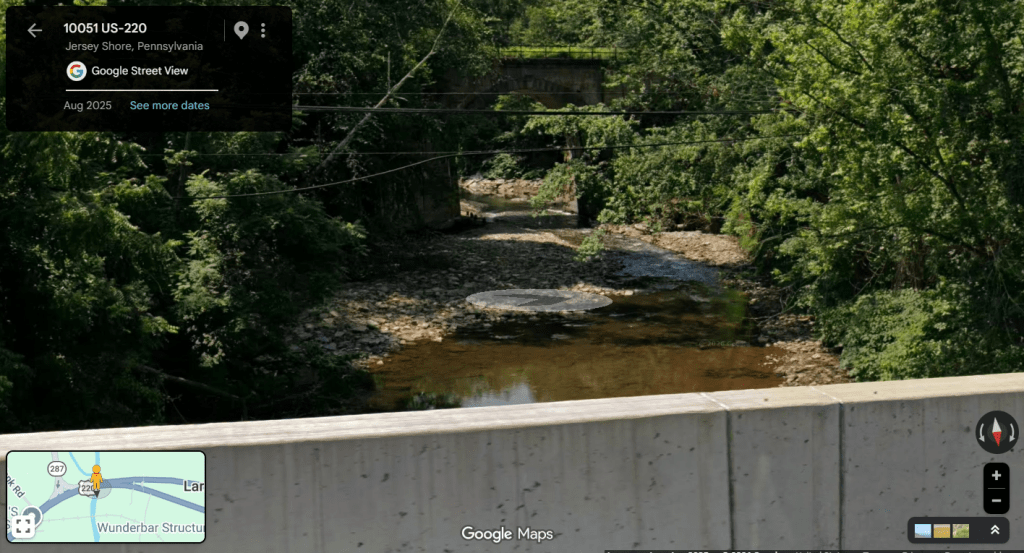
Burkhart later pled guilty to involuntary manslaughter before Judge Harvey W. Whitehead, admitting that he and the rest of the men in the car had been drinking. He was sentenced to six months in the county jail and ordered to pay a $100 fine, which has the purchasing power of nearly $2,000.00 today.
The estate of Jesse Fry was, unfortunately, forced to liquidate the family homestead at 2115 Junction Street to settle $4,000 in debts. I will continue to research this, but the family may have negotiated a payment plan to retain the house and land, or possibly moved out for a time and repurchased the home later. I do know that my grandparents, Jesse A. Jr. (1913-1963) and his wife E. Virginia Sechler Fry (1914-2002), owned the house when I was a child in the 1960s through 1980s. Since then, both have passed, and the home has been sold.


Leave a Reply