
EARLY LIFE IN CENTRAL PENNSYLVANIA
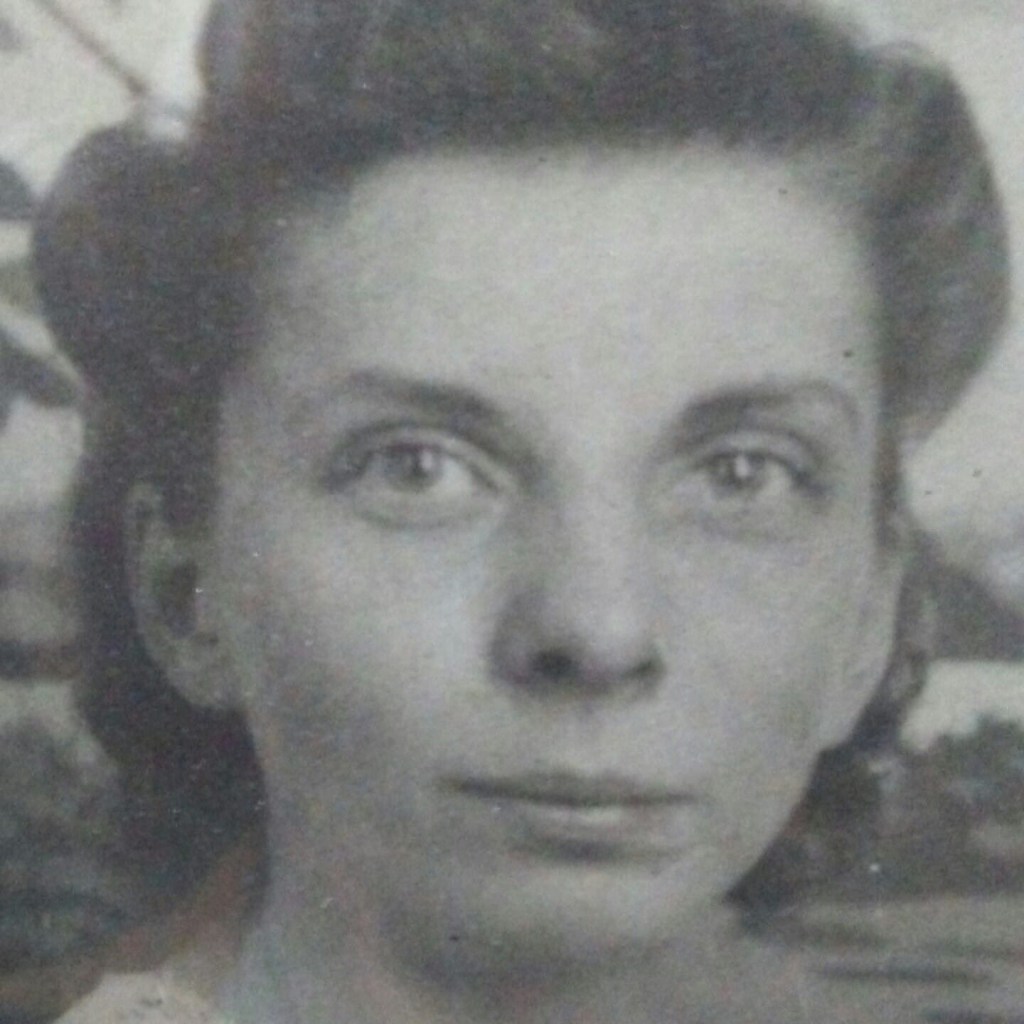
Miriam Fae Phillips was born in Decatur Township, Clearfield County, Pennsylvania on 20 Jun 1918, to Earnest “Vaughn” Phillips (1900-1983) and May Priscilla (Kephart) Phillips (1900-1930). Decatur Township is located near Philipsburg, Pennsylvania on the Clearfield/Centre County border. Vaughn was listed on the 1920 census as working in the clay industry, which is a commonly found in coal mines. This particular high-quality clay in the Clearfield County region was especially good as it was used to make firebricks, sewer pipes, and refractory oven bricks. The coal and brickworks industry in this area helped fuel the industrial revolution! By 1930, their hometown changed to Dysart, Pennsylvania, a small town in Dean Township, Cambria County, Pennsylvania. The family left familiar surroundings, as the 1920 census listed multiple relatives of both sides of their family living along the same road. For many of our family members, this new location may be well known, as Dean Township is directly over the mountain from the Altoona/Bellwood area, traveling west. Vaughn was renting a home and still working in the clay mines. He was listed as a “motorman” which was an important job. He was not only responsible for driving the rail car through the mine, but also maintaining the machine, navigating the treacherous mine track system, and working in dark, damp, poorly ventilated conditions with dangerous equipment. The family had grown considerably since 1920, with Miriam listed as the oldest of 6 children; 3 boys and 3 girls. Miriam was 11 at the time of the census and listed as “able to read and write”. The date listed on the census was April 9, 1930, and unfortunately mother May would become sick by the end of the year and die from pneumonia on December 29, 1930.
We can only imagine the weight placed on the shoulders of a twelve-year-old girl. As the oldest child, Miriam was suddenly left to help anchor a family of five younger siblings in the wake of immense grief. Compounding the tragedy, her father, Vaughn, remarried Martha E. (Shumac) Phillips (1911-2001) on October 27, 1930, in Gormania, West Virginia—a state known at the time for its lenient marriage application laws. Because May did not pass away until December of that year, this rushed union implies a complex, painful family dynamic unfolding behind the scenes. Whatever the circumstances, Miriam was thrust into a maternal role long before her time.
Miriam was back in Decatur Township, Clearfield County in the early 1930s and married Alvie James Kennedy (1909-1972) on 21 June 1935. Ironically, or not, this was one day after Miriam’s 17th birthday. In Pennsylvania in 1935, the legal age to marry without parental consent was 21 for men and women. However, minors as young as 14 for males and 12 for females could marry if they had parental or guardian consent. There must have been some kind of consent, as they visited the Justice of the Peace to certify their marriage. Four days later, on June 25, Miriam gave birth to her first son James Alfred Kennedy (1935-1962). The family continued to grow with the birth of Evelyn Lois (Kennedy) Merritt (1939-2015), and Ronald W. Kennedy (1941-2020). Bernard Lee Kennedy was born in 1937, but passed in 1939 before turning two-years old.
You may recall that the United States was in the middle of the Great Depression at the time, and the 1940 census indicates that Alvie was employed as a road worker for the Works Progress Administration, a government program created to provide jobs during the Depression. His income, at 410 dollars, is equivalent to about $10,000 per year in today’s money. This wasn’t much different than the other folks listed on the census pages for the area; they were all living in extreme poverty, and there were many homes with the Phillips and Kennedy names, all living in the same general vicinity.
MOVE TO NEW YORK
By 1942, the family had relocated to Niagara Falls, New York. They are listed in the city directory from that year, and Alvie was employed by the Great Lakes Carbon Corporation. His address was listed as 5310 Buffalo Avenue, which was actually the address of the corporation. Insight was gained into this sudden job change and relocation after a little further research. This excerpt explains how the family learned of job opportunities in New York state.
“On January 26, 1942, the Great Lakes Carbon Corporation (Electrode Division) officially signed its wartime union contract at this Niagara Falls location with Local 12237 District 50 of the United Mine Workers of America (UMWA), cementing its role in local industrial history during World War II.” New York State Department of Environmental Conservation (NYSDEC)
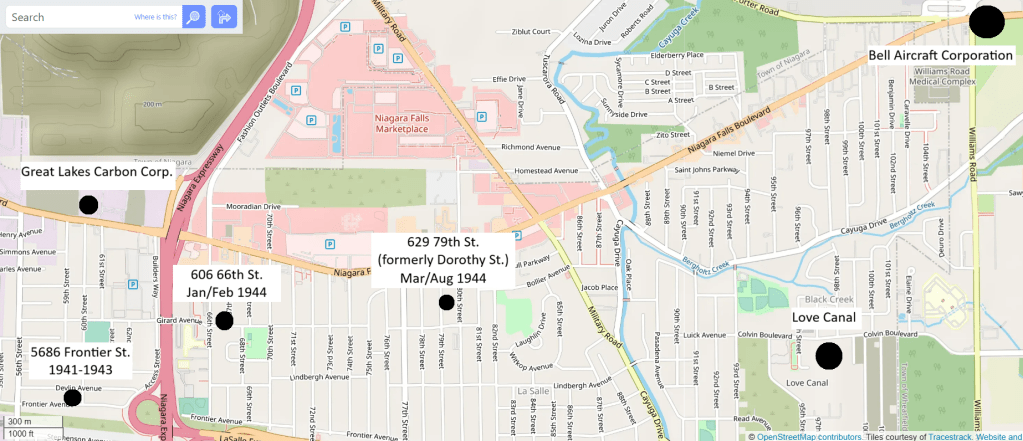
A requested copy of Miriam’s birth certificate, prepared on 17 October 1942, listed their Niagara Falls address as 5686 Frontier Street. Vaughn and Martha relocated before them, and were living in that residence. Geographically, and based on the above information, it makes sense that father, Vaughn Phillips, now worked at the Great Lakes Carbon Corporation. Vaughn’s son-in-law Alvie relocated to work there also. Newspaper articles stated that the Kennedy family lived with her parents beginning April 1941, then moved to the Pine Acres housing development at 606 66th Street on January 1, 1944. They moved again shortly after to 629 Dorothy St. on March 1, 1944. A search of these addresses, the Great Lakes Carbon Corporation and Bell Aircraft, Alvie’s future employer, places the family in La Salle, a blue-collar section of Niagara Falls, adjacent to Love Canal. The defunct canal, originally dug to bypass Niagara Falls, was proposed to compete with a similar canal on the Canadian side. The canal was one mile long, 50 feet wide, and 10-40 feet deep. The project was abandoned after a financial crisis and the invention of hydroelectric power in the United States. After abandonment, the canal was repurposed as a landfill, with many industries in the area producing waste that polluted the landfill as toxins seeped into the groundwater. The family had left the area prior to the worst of the pollution, (Hooker Chemical’s egregious treatment of the landfill in the late 1940s through the 1970s), but our family today believes the children of Miriam may have been affected in some ways.
The family settled into their new hometown. Alvie was working, and they had just moved closer to his new position. Niagara Falls in the early 1940s was booming due to war production. The city grew dramatically in this period, as work was plentiful and wages were good. The hydroelectric power plants fueled aircraft building, chemicals, plastic, synthetic rubber, and explosives. Patriotism was at an all-time high as industry promoted the war effort and the local newspapers continually advertised the need to support the war effort. Niagara Falls at this time was described as “loud, crowded, polluted, and exhausted, but also prosperous and filled with energy in an effort to win World War II. 1944: Buffalo Industry Works for the War – WNY History
A CRUEL ENDING
Miriam’s life ended abruptly on August 4, 1944. Alvie was working his usual second shift until 1 am, but was asked to stay on until 5 am due to an emergency at the Bell Aircraft facility. When he arrived home, he found his wife dead, sexually assaulted and strangled by an intruder. The children were cowering together in another room, completely frightened and in shock. It was discovered that the murder took place just an hour or so before he returned home. When the police were called, they were actually close-by, investigating another home invasion with similar circumstances. At that residence, the killer was scared off by the husband who responded to a window screen rattling on the house and screams coming from another room. The murder case and subsequent trial was covered extensively by Buffalo newspapers, and the offender was sentenced to life in prison for his crimes. Unfortunately, this wasn’t the only tragedy experienced by the family while living in New York. Miriam’s brother, Lee E. Phillips (1925-1944) died from drowning just a few weeks earlier on July 11 while swimming at Buckhorn State Park, Grand Island, New York.
EPILOGUE
Can an event of this magnitude affect a bloodline even if they didn’t know their grandmother/great-grandmother? The Phillips families, after struggling in their own hometown, attempted to move forward and better their lives, but instead suffered unimaginable losses. The children – James, Evelyn, and Ronald, witnessed an event that can never be erased. Evelyn requested that her story someday be told by her daughters, a request that proved very difficult and emotional.
As the years went by, Evelyn shared bits and pieces of her childhood, and the trauma she experienced. She shared stories of poverty where the neighborhood kids chewed on road tar like gum. They lived in an undesirable neighborhood in one of the most polluted areas of the country, but she indicated that they had a happy childhood, something the daughters were never really sure of. The story was finally shared when the daughters were in their teens. Despite this shocking turn, Evelyn persevered and built her own family. The oldest daughter often wonders if the scars of this event, the mental aspects of this terrible tragedy, have been passed down, as we lost Miriam’s great-grandchild to suicide in 2020.


Leave a Reply